Styles8 min read
How tall should a headboard be? Heights, ceilings and costs
Most people only think about headboard height when the bed arrives. A few measurements before you order will tell you whether the standard 54 inches is right, or whether your room can carry more.
In this guide
- What is the standard headboard height in the UK?
- Which headboard height should you choose?
- Is a 60 inch headboard worth it?
- How tall should a headboard be for your ceiling?
- Does the size of the bed change the right height?
- Will a tall headboard get up your stairs?
- Which beds suit a tall headboard?
- Questions
Key takeaways
- There is no official UK standard. Our standard headboard is 54 inches (about 137 cm) from the floor, tall enough to sit up against with pillows behind you.
- Choose 60 inches (152 cm) for more presence in an average room, 72 inches (183 cm) for a statement wall, and 73 to 79 inches only under a high ceiling.
- Before you choose, measure to the ceiling and to anything on the wall behind the bed: windows, shelves, wall lights and switches.
- A wider bed carries a taller headboard: a super king can take a height that would look top-heavy on a double.
- At Bedline, 60 inches adds £119, 72 inches £189 and 73 to 79 inches £279. A split headboard (+£119) helps a tall board up tight stairs.
What is the standard headboard height in the UK?
There is no official standard. Our standard headboard is 54 inches (about 137 cm), measured from the floor to the top of the board, and it suits most bedrooms. It rises well above the pillows, so you can sit up to read with your back and head supported, and it leaves plenty of wall above it under an ordinary ceiling.
Because the figure is measured from the floor, the part you see above the mattress is shorter. A deeper mattress shows a little less of the headboard, so bear that in mind if you add a thick pillow-top mattress with the bed.
Which headboard height should you choose?
Our frames come in four headboard heights, and each one suits a different kind of room.
| Height | About | What it suits | Upgrade cost |
|---|---|---|---|
| 54 in (standard) | 137 cm | Most bedrooms. Comfortable to sit up against, easy to deliver, sits below most windows and shelves | Included |
| 60 in | 152 cm | Kings and super kings in an average room where you want a little more presence | +£119 |
| 72 in | 183 cm | A statement wall in a larger room or under a higher ceiling; winged and Chesterfield designs | +£189 |
| 73 to 79 in | 185 to 201 cm | High-ceilinged period rooms, where a standard board looks lost | +£279 |
The step from 54 to 60 inches adds about 15 cm. It makes the bed look more substantial without changing how the room feels. From 72 inches the headboard starts to fill the wall, and the bed sets the scale of everything else in the room.
Standard or taller?
Keep the standard 54 inches if
- Your ceiling is around 2.4 m or lower
- A window, shelf or wall light sits above the bed
- The bed is a double or smaller
- Your stairs or landing are tight
Go taller if
- The ceiling is high and the wall above the bed feels empty
- The bed is a king or super king
- You sit up in bed to read or watch TV
- You want the bed to be the focal point of the room
Is a 60 inch headboard worth it?
For a king or super king in an average main bedroom, often yes. A 60 inch headboard (about 152 cm) is tall enough to look deliberate and still sits comfortably under a 2.4 m ceiling. At £119 extra, it is the upgrade most rooms can carry.
It also helps if you sit up in bed a lot. The extra height puts padding behind your head as well as your back, which matters when you read or watch TV with the pillows stacked. In a small room with a double, though, keep the standard height and spend the money elsewhere.
How tall should a headboard be for your ceiling?
Ceiling height is the first check. Under a typical 2.4 m ceiling, a 72 inch headboard (183 cm) leaves about 57 cm of wall above it, which still looks balanced. A 79 inch headboard (201 cm) leaves under 40 cm, which can feel cramped. In a period house with a high ceiling, the tallest options fill a wall that would make a standard board look small.
Then look at everything else on that wall. Measure from the floor to each of these:
The ceiling
Measure in the centre of the wall where the bed will go. Leave at least a hand’s width between the top of the headboard and the ceiling, and more under coving or a cornice.
The window sill
If a window sits behind the bed, measure to the bottom of the sill. A headboard that covers part of a window blocks light and makes curtains or blinds awkward to use.
Shelves, wall lights and pictures
Each one sets a limit of its own. Measure to the lowest, and decide whether you would rather move it or choose a lower board.
Switches and sockets
Check that the headboard, and any wings, will not cover a light switch or the sockets you use for lamps and chargers.
Does the size of the bed change the right height?
Yes. A headboard is a rectangle on your wall, and the wider the bed, the taller the headboard it can carry before it looks top-heavy. A super king mattress is 180 cm wide, so a 72 inch (183 cm) headboard on a super king makes a near-square panel of upholstery. The same height on a 135 cm double makes a tall, narrow one.
- standard 54 inch headboard
- 137 cm
- 72 inch headboard
- 183 cm
- tallest option, 79 inches
- 201 cm
As a rough guide, a double or small double looks right at 54 or 60 inches. A king takes 60 or 72 inches comfortably. A super king, especially a winged one, can carry 72 inches or more in a room with the ceiling to match. Our bed size guide has the room sizes for each bed.
Will a tall headboard get up your stairs?
The headboard is the largest single piece of the bed, and height makes it bigger in the direction people forget to measure. A 79 inch headboard on a super king is about 2 m tall and more than 1.8 m wide, and it has to turn on your stairs and landing.
Measure the front door, the hall, the stairs and the turn at the top, including the height of the ceiling over the stairs. If any of them is tight, choose a split headboard for £119. We make it in two halves, which go up the stairs separately and join in the room when the bed is assembled.
Which beds suit a tall headboard?
Almost every frame we make can have a 60, 72 or 73 to 79 inch headboard, but some designs make more of the height than others.
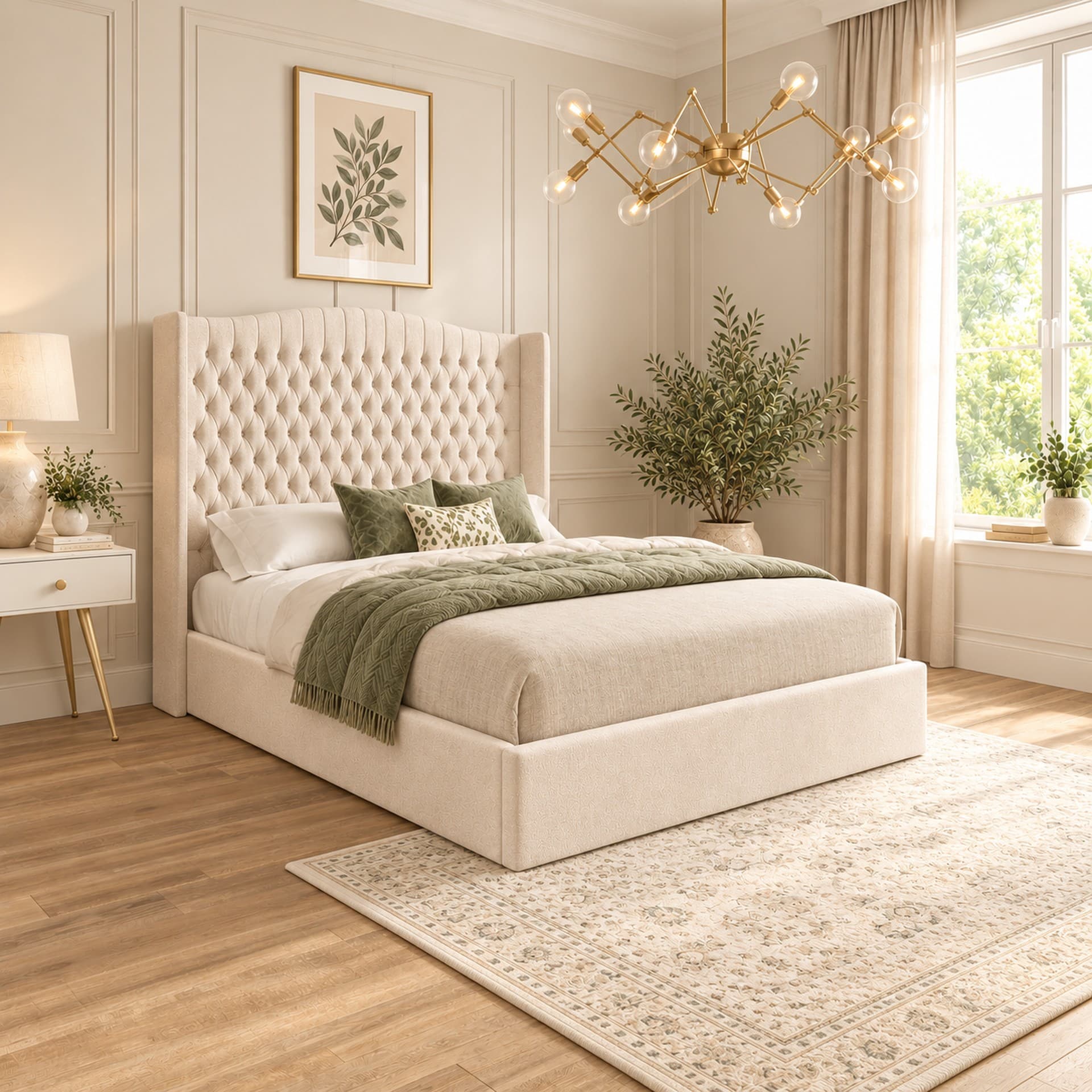
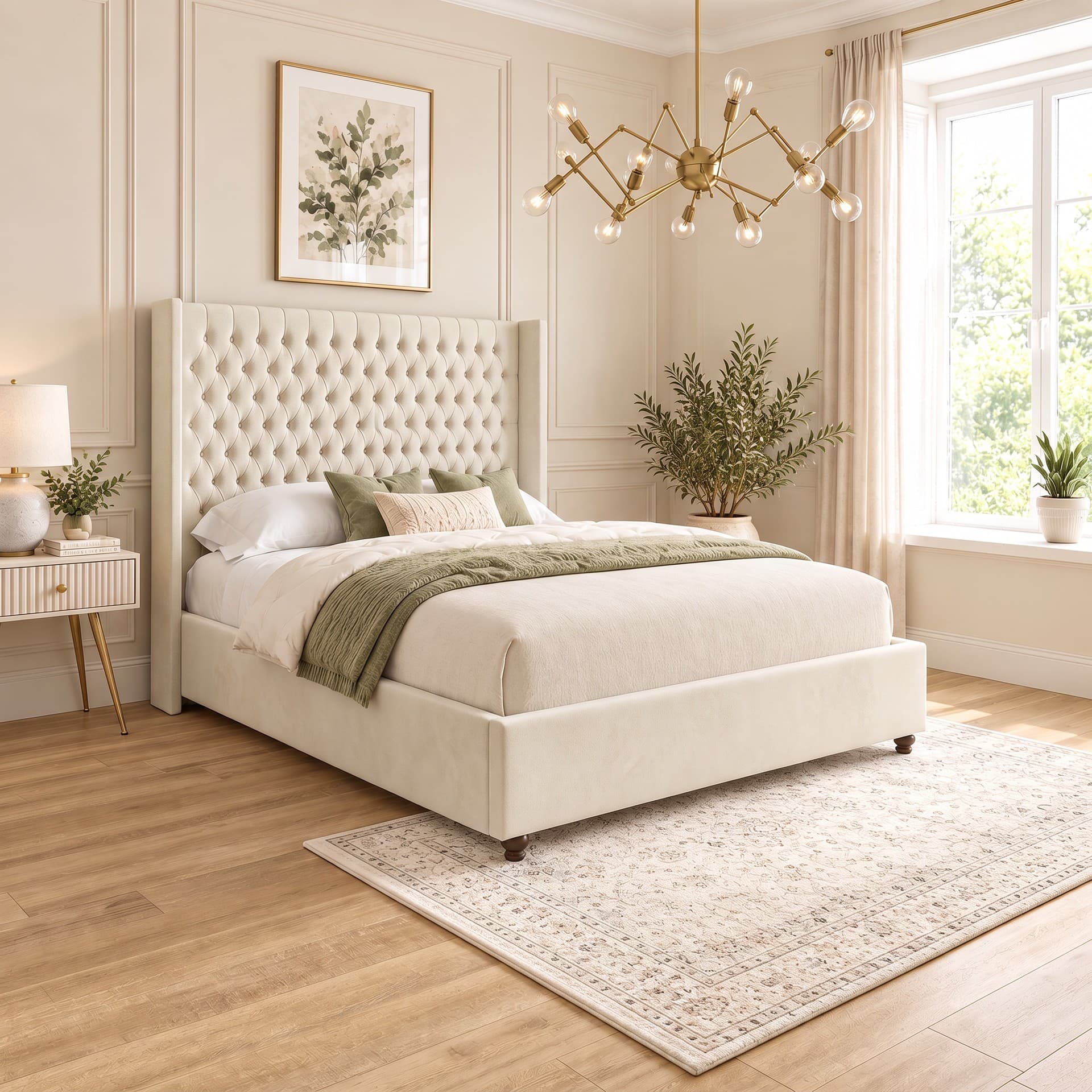
- Tall winged frames like Vivian carry the height into the wings, so the headboard frames the bed like a high-backed chair.
- Floor-standing wings, as on Miriam, run down to the floor and make a tall headboard look anchored.
- Chesterfield buttoning fills a tall panel with pattern. Montauk, with curved wings and deep buttoning, is the most dramatic at full height.
- Plain and panelled headboards stay calm at any height, for a modern room where you want scale without ornament.
See every frame that can go taller in our tall headboard beds, or browse winged beds, where the extra height makes the biggest difference. Our guide to wingback beds explains the wing styles.
Statement beds for a tall headboard
Prices shown are for the super king frame with the standard 54 inch headboard. Choose a taller headboard on the bed page.
 WingedChoose fabric and size
 WingedChoose fabric and size
 WingedChoose fabric and size
The verdict
For most bedrooms, the standard 54 inch headboard is the right height: comfortable to sit up against, easy to deliver and in proportion under an ordinary ceiling. Choose 60 inches for a king or super king where you want more presence, 72 inches for a statement wall in a larger room, and 73 to 79 inches only when the ceiling is high. Measure the wall and the stairs before you order.
Questions people ask
How tall should a headboard be?
For most bedrooms, about 54 inches (137 cm) from the floor. Go to 60 or 72 inches for a king or super king in a larger room, and 73 to 79 inches only under a high ceiling.
What is the standard headboard height in the UK?
There is no official standard. Our standard headboard is 54 inches (about 137 cm) from the floor, with taller options of 60, 72 and 73 to 79 inches.
How tall is a 60 inch headboard in cm?
About 152 cm, measured from the floor. That is roughly 15 cm taller than a standard 54 inch headboard.
Is a tall headboard a good idea in a small room?
Not usually. Under a low ceiling or with a small double, a 54 inch headboard keeps the bed in proportion; height without width can look top-heavy.
What is a floor-standing headboard?
A floor-standing headboard rests on the floor instead of fixing to the wall. On a design like Miriam the wings also run to the floor, which makes a tall headboard look anchored.
Can a tall headboard get up the stairs?
Measure the stairs, the landing and the ceiling over the stairs first. If space is tight, a split headboard, made in two halves, costs £119 at Bedline.
About Bedline
Bedline makes upholstered beds, ottoman beds and TV beds to order in Britain, in six UK sizes and 72 colours, and delivers them free to the UK mainland. Our guides are written by the team who help customers choose their beds every day on WhatsApp, so they answer the questions we are actually asked.